1. Limits and colimits
A category \(\cC\) is a class of objects \(\Ob(\cC)\) and a class of morphisms \(\Hom(A, B)\) between any two objects equipped with a composition law, so that for any \(A, B, C \in \Ob(\cC),\) we have the following:
- An associative composition operator $$ \circ \colon \Hom(B, C) \times \Hom(A, B) \to \Hom(A, C); $$
- Local identities \( \Id_A \colon A \to A \), such that for any \( f \colon A \to B \), we get \( f \circ \Id_A = f \) and \( \Id_B \circ f = f \).
We denote the class of all morphisms in \(\cC\) by \(\Hom(\cC)\).
We define maps between categories \(F \colon \cC \to \CD\) on the level of pairs
\[F \colon (\Ob(\cC), \Hom(\cC)) \to (\Ob(\CD), \Hom(\CD)),\]meaning each object (resp. morphism) in \(\cC\) is mapped to an object (resp. morphism) in \(\CD\). We call \(F\) a functor if it preserves (a) the composition operator
\[F(f \circ g) = F(f) \circ F(g)\]and (b) local identities \(F(\Id_A) = \Id_{F(A)}\).
Remark 1.1. When working with categories, we are interested in when a morphism factors through another one. Intuitively, this abstracts the notion of integers dividing each another, and it leads to the notion of categorical limits and colimits.
Let \(F \colon \CI \to \cC\) be a functor. Here, we call \(F\) a diagram and \(\CI\) the indexing category. We denote an object in the image of \(F\) by \(F(i) = A_i\). The limit of \(F\) is then an object \(\lim A_i\) in \(\cC\) equipped with a morphism
\[f_m \colon \lim A_i \to A_m\]for each \(m \in \CI\), such that:
- For any morphism \( \phi \colon m \to n \) in \( \CI \), we have \( F(\phi) \circ f_m = f_n \);
- Any other compatible collection of morphisms \( g_m \colon \CO \to A_m \), meaning a cone over the diagram, factors through the limit: there exists a unique \( h \colon \CO \to \lim A_i \) making this diagram commute: $$ \xymatrix{ & \CO \ar@{.>}[d]|-{\exists !h} \ar@/_/[ddl]_{g_m} \ar@/^/[ddr]^{g_n} & \\ & \lim A_i \ar[dl]^{f_m} \ar[dr]_{f_n} & \\ A_m \ar[rr]_{F(\phi)} & & A_n. } $$
There is likewise the dual notion of the colimit of \(F\), which is given by reversing the arrows in the definition of a limit. Explicitly, the colimit is an object \(\displaystyle \colim A_i\) in \(\cC\) equipped with a morphism
\[\displaystyle f_m \colon A_m \to \colim A_i\]for each \(m \in \CI\), such that:
- For any morphism \( \phi \colon m \to n \) in \( \CI \), we have \( f_m = f_n \circ F(\phi); \)
- Any other compatible collection of morphisms \( g_m \colon A_m \to \CO \), meaning a cocone under the diagram, factors through the colimit: there exists a unique \( \displaystyle h \colon \colim A_i \to \CO \) making this diagram commute: $$ \xymatrix{ A_m \ar[rr]^{F(\phi)} \ar@/_/[ddr]_{g_m} \ar[dr]^{f_m} & & A_n \ar@/^/[ddl]^{g_n} \ar[dl]_{f_n} \\ & \colim A_i \ar@{.>}[d]|-{\exists !h} & \\ & \CO & } $$
Let \(f \colon A \to B\) be a morphism. If there exists a map \(f^{-1} \colon B \to A\) such that \(f \circ f^{-1} = \Id_B\) and \(f^{-1} \circ f = \Id_A\), then we call \(f\) an isomorphism. Likewise \(A\) and \(B\) are said to be isomorphic, which we denote \(A \cong B\). For sets an isomorphism is a bijection; for groups it is the usual notion of an isomorphism; for topological spaces it is a homeomorphism; etc.
Proposition 1.2. The limit (resp. colimit) of a diagram is unique up to isomorphism.
Proof. Suppose \(L_1\) and \(L_2\) are both limits of a given diagram. Their universal properties give unique morphisms \(h \colon L_1 \to L_2\) and \(k \colon L_2 \to L_1\) compatible with the two limiting cones. Both \(k \circ h\) and \(\Id_{L_1}\) are morphisms \(L_1 \to L_1\) compatible with the cone, so uniqueness gives \(k \circ h = \Id_{L_1}\). Similarly, \(h \circ k = \Id_{L_2}\). Thus \(h\) is an isomorphism. The colimit case is dual. \(\blacksquare\)
Remark 1.3. In arbitrary categories limits (resp. colimits) do not always exist. Hence, this definition describes limits, unique up to isomorphism, under the assumption that they can be constructed.
2. Products and coproducts
We call the limit over a diagram \(F \colon \CI \to \cC\) such that \(\CI\) has only identity morphisms
\[\Hom_{\CI}(m, n) = \begin{cases} \{ \Id_m \} & \text{ if } m = n \\ \varnothing & \text{ if } m \neq n \end{cases}\]a product, which is denoted
\[\prod A_i = \lim A_i.\]This is the same as choosing an indexed family of objects \(\{ A_i \}\) in \(\cC\) with projections satisfying the following universal property:
\[\xymatrix{ \CO \ar@{.>}[d]|-{\exists !h} \ar[dr]^{g_m} \\ \prod A_i \ar[r]_{\pi_m} & A_m. }\]Here, we have replaced \(f_m\) with \(\pi_m\), which we call the projection onto \(A_m\).
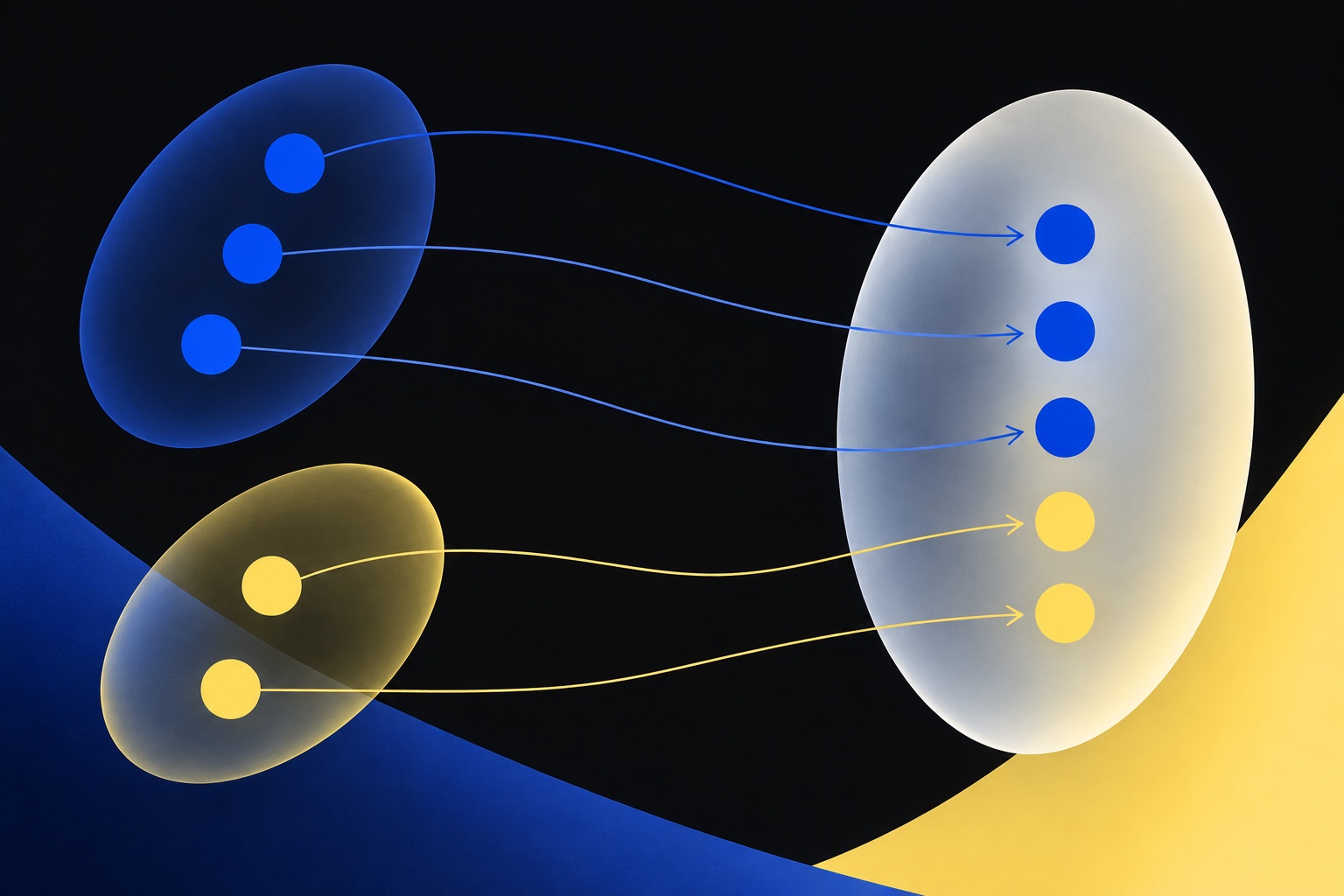
We likewise define the coproduct as the colimit over diagrams with no nonidentity morphisms, which we denote
\[\coprod A_i = \colim A_i,\]This is equivalent to choosing an indexed family of objects \(\{ A_i \}\) in \(\cC\) with injections satisfying the following universal property:
\[\xymatrix{ A_m \ar[dr]_{g_m} \ar[r]^{\iota_m} & \coprod A_i \ar@{.>}[d]|-{\exists !h} \\ & \CO }\]We call the maps \(\iota_m\) the injections of the objects \(A_m\) into the coproduct.
Example 2.1. The following table gives common names of products and coproducts in different categories. Schemes are more nuanced because of the contravariant nature of the Spec functor: finite products and arbitrary coproducts exist, while infinite products of general schemes need not exist.
| Category | Product | Coproduct |
|---|---|---|
| Sets | Cartesian product | Disjoint union |
| Groups | Direct product | Free product |
| Abelian groups | Direct product | Direct sum |
| Unital rings | Direct product | Free product amalgamated over \(\ZZ\) |
| Commutative rings | Direct product | Tensor product (over \(\ZZ\)) |
| \(R\)-modules | Direct product | Direct sum |
| \(k\)-vector spaces | Direct product | Direct sum |
| Topological spaces | Cartesian product with the product topology | Disjoint union |
| Pointed topological spaces | Cartesian product with the product basepoint | Wedge sum |
| Schemes | Fiber product over \(\operatorname{Spec}(\ZZ)\) | Disjoint union |
| Poset | Infimum | Supremum |
We briefly detail the last example: that for a poset, i.e. a partially ordered set, the product is the infimum and the coproduct is the supremum. Recall that a set \(X\) equipped with a relation \(\leq\) is called a poset if it satisfies
- \( x \leq x \),
- \( x \leq y \) and \(y \leq x \) implies \( x = y \), and
- \( x \leq y \) and \( y \leq z \) implies \( x \leq z \).
Associated to any poset \(X\) is a category whose objects are the elements of \(X\) and morphisms represent the relation, meaning
\[\Hom(x, y) = \begin{cases} \text{a single morphism} & \text{ if } x \leq y \\ \varnothing & \text{ else.} \end{cases}\]We see that in this category for a family of elements \(\{ x_i \}\) in \(X\), the product diagram
\[\xymatrix{ y \ar@{.>}[d]|-{\exists !h} \ar[rd]^{g_m} \\ \prod x_i \ar[r]_{\pi_m} & x_m. }\]reads as follows: “Any \(y\) which is less than each \(x_n\) is less than their product.“ Hence, their product is the greatest element less than our collection \(\{ x_i \}\), meaning it is their infimum. Likewise their coproduct is their supremum.
Remark 2.2. Recall that the class of sets is partially ordered by inclusion. For a collection of sets \(\{X_i\}\), the infimum is their intersection \(\bigcap X_i\), and the supremum is their union \(\bigcup X_i\). Hence, in this poset category, intersections and unions are category theoretic products and coproducts, respectively. This interests us since the natural numbers \(\NN\) are recursively constructed using unions; omitting details, we set \(0 = \varnothing\) and define the successor by \(n+1 = n \cup \{ n \}\). The integers \(\ZZ\) can then be constructed as the group completion of the additive monoid \(\NN\). This process motivates the analogous group-completion construction in K-theory.
3. K-theory
Let \(\cC\) be an essentially small category equipped with finite coproducts, which in this section we denote by \(\oplus\). Objects being isomorphic is an equivalence relation. Thus, if \(A\) and \(B\) are isomorphic, then we say that \(A\) and \(B\) belong to the same isomorphism class, which we denote \([A] = [B]\). We write \(\pi_0(\cC^{\simeq})\) for the set of isomorphism classes in \(\cC\).
Coproduct makes this set a commutative monoid:
\[[A] + [B] = [A \oplus B],\]where commutativity follows from \(A \oplus B \cong B \oplus A\). Its group completion is constructed as follows.
Write \((M, +)\) for a commutative monoid and an element of \(M \times M\) as a pair \((m^+, m^-)\). Consider two such pairs \((m_1^+, m_1^-)\) and \((m_2^+, m_2^-)\). We add them component-wise
\[(m_1^+, m_1^-) + (m_2^+, m_2^-) = (m_1^+ + m_2^+, m_1^- + m_2^-),\]and we consider them to be equivalent if there exists an \(a \in M\) such that
\[m_1^+ + m_2^- + a = m_2^+ + m_1^- + a.\]We call \(M \times M\) modulo this equivalence relation the Grothendieck group of \(M\); the inverse of the class of \((m^+,m^-)\) is represented by \((m^-,m^+)\).
Returning to \(\cC\), we call the resulting group the split K-group \(K_0^{\oplus}(\cC)\). If \(\cC\) is instead an abelian category, or more generally an exact category, its usual group \(K_0(\cC)\) is the free abelian group on isomorphism classes modulo the relations
\[[B]=[A]+[C]\]for every short exact sequence \(0 \to A \to B \to C \to 0\). When every short exact sequence splits, these two constructions agree.
Example 3.1. In the category of finite sets, an isomorphism is a bijection, meaning we can associate with each isomorphism class a natural number, i.e. its cardinality. We see that the coproduct here is disjoint union
\[X \coprod Y = X \times \{0\} \cup Y \times \{1\},\]which is indeed the usual notion of addition on \(\NN\). Thus, the \(K\)-group of finite sets is \(\ZZ\). Furthermore, (Cartesian) products of sets allow us to define multiplication.
Example 3.2. Write \(X\) for a compact Hausdorff space, and consider the category of finite-rank real vector bundles on \(X\) under Whitney sum. The group completion of its monoid of isomorphism classes is denoted \(KO^0(X)\) and is called real topological K-theory.
Example 3.3. Let \(R\) be a ring, and consider the category of finitely generated projective \(R\)-modules under direct sum. We denote the group completion of its monoid of isomorphism classes by \(K_0(R)\). It is the zeroth algebraic K-group of \(R\).
The following theorem motivates the use of projective modules in algebraic K-theory. Note that higher (and lower) K-groups can be defined; we have given the base case.
Serre-Swan Theorem. Let \(X\) be compact Hausdorff and \(\cC(X)\) its algebra of continuous functions \(f \colon X \to \RR\). Sending a finite-rank real vector bundle on \(X\) to its \(\cC(X)\)-module of continuous sections gives an equivalence with the category of finitely generated projective \(\cC(X)\)-modules. Consequently,
\[KO^0(X) \cong K_0(\cC(X)).\]Proof. Serre originally proved a similar statement for the prime spectrum of commutative rings in [4]. The above statement was shown by Swan in [5]. A generalization is given in [3]. \(\blacksquare\)
4. References
- Alexander Grothendieck, Sur quelques points d’algèbre homologique, I, Tohoku Mathematical Journal 9 (1957), no. 2, 119–221.
- Saunders Mac Lane, Categories for the working mathematician, Springer, 1978.
- Archana S. Morye, Note on the Serre-Swan theorem, Mathematische Nachrichten 286 (2013), no. 2-3, 272–278.
- Jean-Pierre Serre, Faisceaux algébriques cohérents, Annals of Mathematics 61 (1955), no. 2, 197–278.
- Richard Swan, Vector bundles and projective modules, Transactions of the American Mathematical Society 105 (1962), no. 2, 264–277.